Prompt
Description
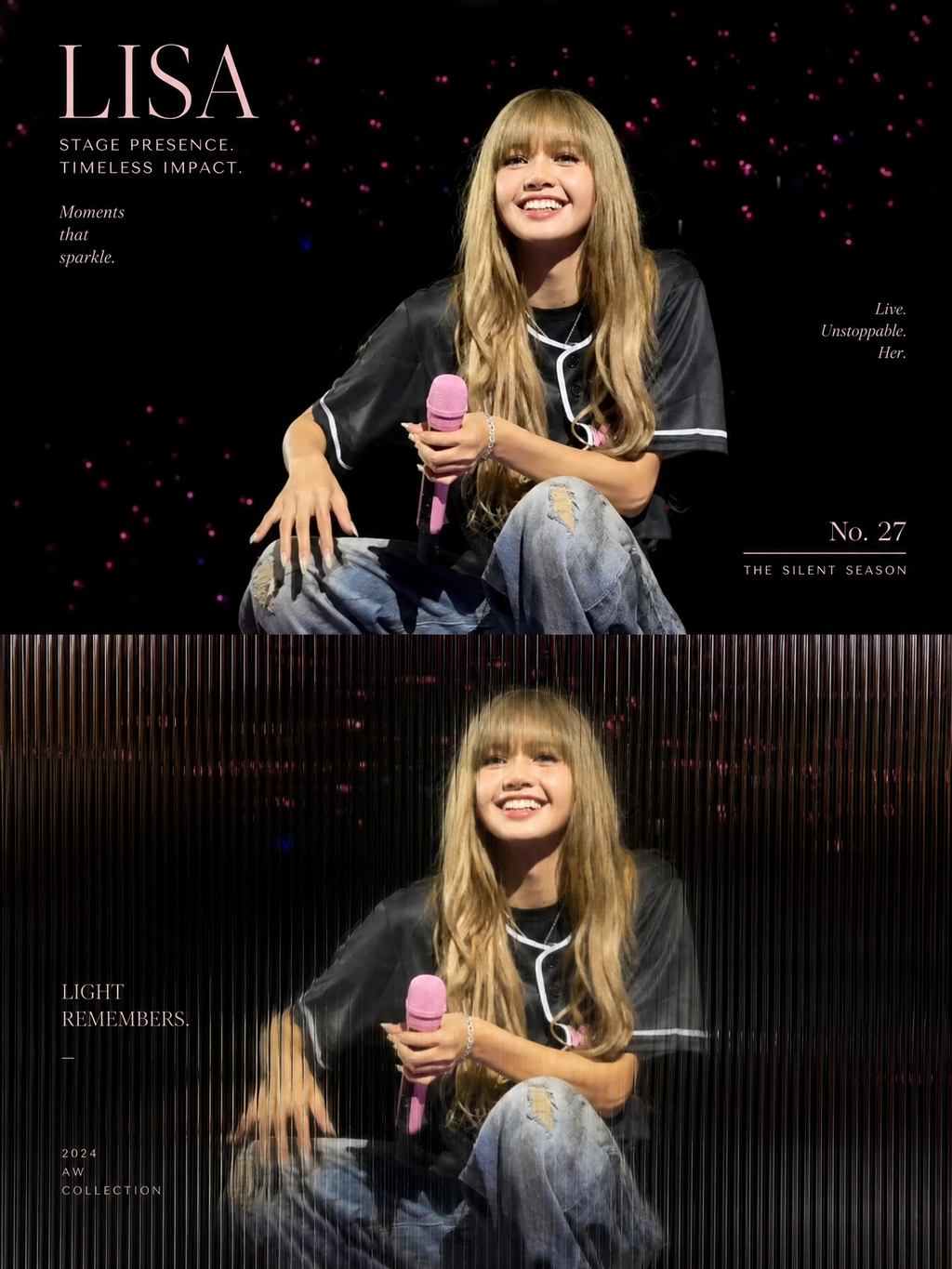
Each uploaded photo generates an independent high-end art double poster, which is not spliced, mixed, or inconsistent with different photos.The canvas is strictly a 3:4 vertical version, with the upper and lower areas accounting for 50% each, and it is naturally delimited by a clean and straight horizontal line. No photo frames, cards, tape, torn paper, crimping, collage shadows or decorative boundaries are used.The overall integration of real photography, luxury advertising, experimental photography, modern optical art, minimalism and advanced editorial design.The upper half of the area completely retains the corresponding original photos, and the identity, facial features, eyes, demeanor, hair, clothing, movements and posture of the characters or animals are consistent; the outline, structure, location, material, perspective, environment, depth of field, natural light and shadow and color relationship of flowers, plants, buildings, landscapes, vehicles and still lifes shall not be changed.Only slightly advanced color grading, exposure optimization, and natural background extension are allowed, and the subject must not be stretched, distorted, replaced, or irrelevant elements added.The full version of the original photo covers half of the area, reaching the top, left and right edges and the central dividing line, showing a real and delicate art magazine photography texture.The lower half of the area is based on the same original photo as the only visual basis, retaining the identity of the subject, key structure, posture, spatial relationship and original color, and covering a whole piece of 100% full version of ultra-dense, ultra-fine, continuous longitudinal changhong glass in front of the entire area. The glass extends from the top of the lower half to the bottom and covers the left and right edges.The texture direction is strictly longitudinal, and the density is about 3-5 times that of ordinary Changhong glass, forming a very fine and continuous miniature optical grating; the glass must have true transparency changes, soft high light, edge reflection, light transmission and refraction levels, and must not be manifested as striped stickers, ordinary blinds, rain glass, motion blur or simple digital filters.The subject and the background are distorted, misaligned, stretched, prism split and refracted by slender ribbons through longitudinal ripples, but the physical structure of the subject cannot be changed by mistake.Automatically identify the visual center according to the original photo: the eyes and faces of people or animals, the hearts of flowers, the structure of architectural signs, the focus of landscapes, or the core details of still lifes.The glass in the central area still exists, but maintains about 85%-95% visual transparency and weak refraction, making key identification features clear and legible; smoothly enhances refraction from the center to the surroundings, avoiding circular, rectangular or blunt mask boundaries; the periphery forms a dense longitudinal light band of about 75%-95% intensity, morphological division and abstract light and shadow, while retaining the overall composition and color memory of the original photo.It is forbidden for the subject to disappear, repeat, break, misalignment of facial features, or deformation of limbs.The background and refracted colors are extracted from the original photo, and low-contrast environments can be used, cream white, warm beige, light gray or soft gradients.The use of soft commercial photography light distribution, highlighting the real glass texture, to avoid overexposing reflective neon color messy spots and cheap special effects.Add a small number of English titles, short subheadings or numbers with true meaning, use slender high-contrast Serif serif fonts and simple Sans-serif small print, free asymmetric typesetting, does not block the focus of the subject, and does not appear garbled, pseudo-English, and watermarks.
The Prompt
Each uploaded photo generates an independent high-end art double poster, which is not spliced, mixed, or inconsistent with different photos.The canvas is strictly a 3:4 vertical version, with the upper and lower areas accounting for 50% each, and it is naturally delimited by a clean and straight horizontal line. No photo frames, cards, tape, torn paper, crimping, collage shadows or decorative boundaries are used.The overall integration of real photography, luxury advertising, experimental photography, modern optical art, minimalism and advanced editorial design.The upper half of the area completely retains the corresponding original photos, and the identity, facial features, eyes, demeanor, hair, clothing, movements and posture of the characters or animals are consistent; the outline, structure, location, material, perspective, environment, depth of field, natural light and shadow and color relationship of flowers, plants, buildings, landscapes, vehicles and still lifes shall not be changed.Only slightly advanced color grading, exposure optimization, and natural background extension are allowed, and the subject must not be stretched, distorted, replaced, or irrelevant elements added.The full version of the original photo covers half of the area, reaching the top, left and right edges and the central dividing line, showing a real and delicate art magazine photography texture.The lower half of the area is based on the same original photo as the only visual basis, retaining the identity of the subject, key structure, posture, spatial relationship and original color, and covering a whole piece of 100% full version of ultra-dense, ultra-fine, continuous longitudinal changhong glass in front of the entire area. The glass extends from the top of the lower half to the bottom and covers the left and right edges.The texture direction is strictly longitudinal, and the density is about 3-5 times that of ordinary Changhong glass, forming a very fine and continuous miniature optical grating; the glass must have true transparency changes, soft high light, edge reflection, light transmission and refraction levels, and must not be manifested as striped stickers, ordinary blinds, rain glass, motion blur or simple digital filters.The subject and the background are distorted, misaligned, stretched, prism split and refracted by slender ribbons through longitudinal ripples, but the physical structure of the subject cannot be changed by mistake.Automatically identify the visual center according to the original photo: the eyes and faces of people or animals, the hearts of flowers, the structure of architectural signs, the focus of landscapes, or the core details of still lifes.The glass in the central area still exists, but maintains about 85%-95% visual transparency and weak refraction, making key identification features clear and legible; smoothly enhances refraction from the center to the surroundings, avoiding circular, rectangular or blunt mask boundaries; the periphery forms a dense longitudinal light band of about 75%-95% intensity, morphological division and abstract light and shadow, while retaining the overall composition and color memory of the original photo.It is forbidden for the subject to disappear, repeat, break, misalignment of facial features, or deformation of limbs.The background and refracted colors are extracted from the original photo, and low-contrast environments can be used, cream white, warm beige, light gray or soft gradients.The use of soft commercial photography light distribution, highlighting the real glass texture, to avoid overexposing reflective neon color messy spots and cheap special effects.Add a small number of English titles, short subheadings or numbers with true meaning, use slender high-contrast Serif serif fonts and simple Sans-serif small print, free asymmetric typesetting, does not block the focus of the subject, and does not appear garbled, pseudo-English, and watermarks.